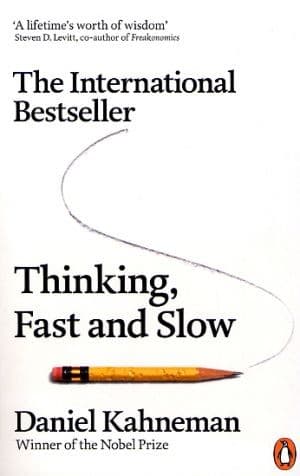
A classic tour of cognitive biases and two-mode thinking. Readers call it mind-expanding and frequently cite it in debates about judgment—though many warn it’s dense and some point to replication-era critiques of a few studies.
Why It's Popular Right Now
It became the default mainstream gateway into cognitive bias and behavioral economics: a Nobel laureate explaining why smart people still make dumb mistakes, using memorable labels that spread far beyond the book.
Contents
Core Concepts
A crowd-favorite explanation of why your brain feels smart while still making predictable mistakes: most of the time you run on fast intuition, and only sometimes engage slow, effortful reasoning. Kahneman then maps the most common bias traps and how they distort judgments about risk, evidence, and prediction.
System 1 vs System 2
Fast intuition handles most daily thinking; slow reasoning steps in when you deliberately pay attention—often too late.
Anchoring
The first number you hear quietly pulls your estimates, even when you know it’s irrelevant.
Availability
What’s vivid or recent feels more common and more important than it really is.
WYSIATI
“What you see is all there is”: we build confident stories from incomplete evidence.
Loss aversion
Losses loom larger than gains, shaping risk-taking and satisfaction.
Overconfidence
We routinely overestimate what we know and underestimate uncertainty—especially in predictions.
The Reading Experience
Most readers treat it as a “chapter-a-week” book. If you binge, the biases blur together—reading slowly makes the concepts stick.
The Honest Take
Curated from 10.8K+ community discussions
Read If
- •You want a foundational mental model for how judgment and decision-making go wrong.
- •You enjoy slow, idea-dense nonfiction and don’t mind academic detours.
- •You work in product, investing, policy, or research and care about bias-aware thinking.
- •You like books that change how you interpret your own reactions and intuitions.
Skip If
- •You’re looking for a step-by-step self-help playbook with exercises and habit plans.
- •You bounce off long, lecture-like chapters and want a tight, modern summary instead.
- •You’re sensitive to “pop science” vibes and want only the most replication-hardened claims.
- •You want novelty—most concepts have been widely summarized online.
What Works
A sticky mental model (System 1 / System 2)
r/books 476“*Thinking, Fast and Slow* and *Noise* profoundly changed the way I think about stuff. RIP Dr. Kahneman Z"L.”
Bias catalog that actually shows up in real decisions
r/books 138“I'm currently reading Thinking, Fast and Slow and loving every page of it. This news just hits a little hard because of that. Rip.”
Makes you less certain—and that’s a feature
r/books 49“Let's use concrete examples. Suppose you have three classes: Class A, Class B, and Class C. All three classes have identical behavior patterns: meaning that on some days they're good, and some days they're bad, and most days they're average — and the behavior is random, meaning that today's behavior doesn't predict tomorrow's. Now, suppose that on Day 1 of the school year, Cl”
Useful for product, investing, and policy debates
r/AutisticWithADHD 45“I'm increasingly convinced that part of autism for many of us is having to constantly use system 2 type thinking because we just *can't* use system 1 type thinking. Hence everyone saying "You're overthinking it!" all the time. Or, to put it another way, we're doing consciously and manually what's supposed to be done unconsciously and automatically. Yes, no wonder we're so ti”
What Falls Flat
It can feel long, dry, and repetitious
r/todayilearned 108“Yesterday I posted a TIL making the opposite claim: http://imgur.com/a/BPG9v and it got about 8,000 upvotes before someone posted that the study had been debunked and I should delete it before it spreads further misinformation: http://imgur.com/a/A4aGG so I deleted it. (I actually didn't know that you still get to keep the karma from an upvoted post even after you delete it :”
Replication-era critiques create “how much should I trust this?” anxiety
r/CGPGrey 99“A large issue with the replication crisis is that journals (and scientists) have for decades preferred publishing *positive* results only, whereas negative results are in many cases equally, if not more valuable.”
Not a “fix your life” manual
r/slatestarcodex 78“Ok so the article itself is actually pretty good but I think the thread title here is completely unwarranted given the actual content of the post. I haven't read the book, but the level of critique is one that I think could fairly be leveled at just about every single pop science book that has ever been written, and less strong than the the criticisms that could be leveled at ”
Real-Life Impact
“*Thinking, Fast and Slow* and *Noise* profoundly changed the way I think about stuff. RIP Dr. Kahneman Z"L.”
“Quality post. I've been quite uncomfortable with public-facing "science books", certainly any best-seller. At best, they take a snapshot of the state of research at a particular moment in time, much of which will turn out to be of exaggerated importance or not replicate at all, and they hand off this snapshot to lay audiences, usually with a lot of Gladwell-esque narrative and”
“I'm currently reading Thinking, Fast and Slow and loving every page of it. This news just hits a little hard because of that. Rip.”
“It's a great point and a bone of contention between the so called medical view and the social view of autism IMO. A study of older autistic adults found a big discrepancy between what they call objective quality of life and subjective quality of life. Many older autists lived without support, some worked, some had friends and some had family. Model citizens you might say acco”
“Yesterday I posted a TIL making the opposite claim: http://imgur.com/a/BPG9v and it got about 8,000 upvotes before someone posted that the study had been debunked and I should delete it before it spreads further misinformation: http://imgur.com/a/A4aGG so I deleted it. (I actually didn't know that you still get to keep the karma from an upvoted post even after you delete it :”
“Nothing in life is as important as you think it is while you are thinking about it.”
— Daniel Kahneman
The Quotes
From the Book
“Nothing in life is as important as you think it is while you are thinking about it.”
“A reliable way to make people believe in falsehoods is frequent repetition, because familiarity is not easily distinguished from truth.”
“We can be blind to the obvious, and we are also blind to our blindness.”
From the Crowd
“*Thinking, Fast and Slow* and *Noise* profoundly changed the way I think about stuff. RIP Dr. Kahneman Z"L.”
r/books 476“I'm currently reading Thinking, Fast and Slow and loving every page of it. This news just hits a little hard because of that. Rip.”
r/books 138“From the Wikipedia page about the Replication Crisis: >Nobel laureate and professor emeritus in psychology ***Daniel Kahneman argued that the original authors should be involved in the replication effort*** because the published methods are often too vague. Of course he argues that...”
r/CGPGrey 48“Worth noting that The Undoing Project about Kahneman and and Tversky is a great book”
r/books 41“If you read it, also go for 'the enigma of reason'. It has some counters to offer for kahneman's 'slow' and 'fast' brain system”
r/Indianbooks 23“If you truly want more of this, then consider “The Undoing Project” by Michael Lewis which is a sort of a biography of Kahneman and Taversky and the work they did together. It will be somewhat repetitive and it is certainly “fluffier” than TFTS but there are some ways in which it is a good complement and companion to the book.”
r/suggestmeabook 15The Crowd Splits: The Debate
While generally beloved, the community is divided on the book's depth and originality.
Is it brilliant science writing, or overrated pop-science that aged poorly in the replication era?
Is the book useful for changing behavior, or mostly descriptive (insight without a playbook)?
The Bookshelf
Read Instead

Predictably Irrational
Dan Ariely
“More anecdotal and lighter; a friendlier intro to behavioral quirks.”
Buy on Amazon
Misbehaving
Richard H. Thaler
“A history of behavioral economics with more narrative and less lab-psych tour.”
Buy on Amazon
Superforecasting
Philip E. Tetlock
“If you want “how to get better at judgment” with clearer training loops.”
Buy on AmazonRead Next

Noise
Daniel Kahneman
“Extends the ideas into decision variability and organizational judgment.”
Buy on Amazon
The Undoing Project
Michael Lewis
“Narrative account of Kahneman & Tversky; great companion context.”
Buy on Amazon
The Signal and the Noise
Nate Silver
“If the book made you care about prediction, this deepens that thread.”
Buy on AmazonGo Deeper
Judgment under Uncertainty
Daniel Kahneman, Paul Slovic, Amos Tversky
“Academic sourcebook behind many ideas; dense but definitive.”
Buy on Amazon
The Scout Mindset
Julia Galef
“Modern, practical approach to motivated reasoning and truth-seeking.”
Buy on Amazon
Factfulness
Hans Rosling
“If you want a bias-aware worldview with more optimism and data literacy.”
Buy on AmazonWhat Readers Ask
It’s about how human judgment actually works in the real world—and why it predictably goes wrong. Kahneman explains two “modes” of thought (fast intuition vs slow deliberation) and uses them to unpack biases that distort estimates, choices, and forecasts.
If you remember one thing, it’s this: your mind defaults to fast, intuitive System 1, and System 2 is the slower referee that often arrives late. Many mistakes happen when System 1 confidently answers a hard question by substituting an easier one (and you don’t notice the swap).
The Culture
In the Wild
Critics & Podcasts
- www.amazon.com — Review/summary/critique reference for readers who want a faster pass or counterpoints.
- en.wikipedia.org — Review/summary/critique reference for readers who want a faster pass or counterpoints.
- dn790002.ca.archive.org — Review/summary/critique reference for readers who want a faster pass or counterpoints.
- www.reddit.com — Review/summary/critique reference for readers who want a faster pass or counterpoints.
- machine-learning-made-simple.medium.com — Review/summary/critique reference for readers who want a faster pass or counterpoints.
What Kind of Book Is This?
Community Tags

Daniel Kahneman
Author Credibility
Daniel Kahneman was a psychologist and Nobel Prize–winning economist whose work (often with Amos Tversky) reshaped how we understand judgment under uncertainty. His research helped found behavioral economics and popularized the study of cognitive biases.
Community Trust: High. Readers generally treat Kahneman as unusually credible: he’s an academic with decades of influential research and a Nobel Prize, and the book is viewed as a foundational synthesis rather than a guru playbook. The main caveat raised in discussions is the replication-era scrutiny of specific effects—but even critics tend to frame the overall lens as valuable while debating individual studies.
How to Read This
Best as: Paperback (slow), or audiobook + notes
Most readers treat it as a “chapter-a-week” book. If you binge, the biases blur together—reading slowly makes the concepts stick.
Shelf Life
Re-read sections as a reference
People revisit chapters on bias, forecasting, and risk when they’re making big decisions or debating evidence.
Homework Level
Light
Not an exercise-driven book. The “homework” is noticing bias in the wild and building better decision habits (checklists, outside view, base rates).
Best Life Stage
Any time you’re making higher-stakes decisions
Especially useful when your work involves judgment under uncertainty: leadership, investing, product, hiring, policy, research.
Still a classic, but people now read it with replication-era caveats
A noticeable slice of discussion frames it as hugely influential while also pointing out that parts of social-psych research culture have been challenged since 2011. Many recommend pairing it with newer work (or critiques) rather than treating every study as gospel.
crowd consensus
Some claims are debated; treat specific studies as examples, not laws
In comment threads, readers argue about whether particular priming/bias findings replicate. The practical takeaway is robust (humans are inconsistent under uncertainty), but individual “effects” can be shakier than the narrative implies.
crowd consensus
More “how humans misjudge” than “how to optimize your life”
Even fans warn it’s not a productivity book. It’s closer to behavioral economics / cognitive psychology—useful for decisions, UX, investing, and debating—but not structured as self-improvement homework.
editorial
If you recommend this, you’re signaling “I care about rigorous thinking”
On Reddit it’s treated as a status-marker classic—often mentioned alongside other “serious” nonfiction. Recommending it says you like first-principles explanations and you’re wary of intuition.
crowd consensus
System 1 vs System 2 isn’t “bad vs good” thinking
Readers often reduce the book to a simple meme: intuitive = wrong, analytical = right. The book’s stronger point is that System 1 is indispensable (speed, pattern recognition), but it’s also vulnerable to predictable bias—especially under uncertainty and noisy feedback.
crowd consensus