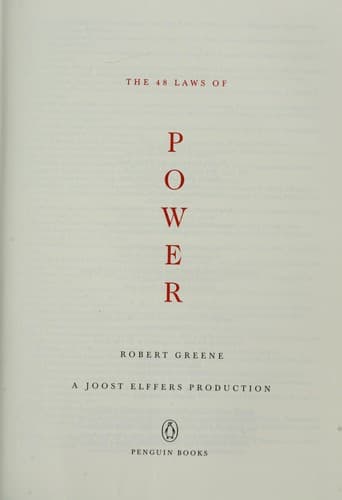
A ruthless ‘how power works’ classic that people either treat as a social‑dynamics manual or reject as edgy manipulation—most agree it’s more diagnostic than aspirational.
Why It's Popular Right Now
It’s endlessly quotable, structured as 48 bite-size rules, and it gives people a vocabulary for office politics and social chess—especially appealing when you’ve been naïve and want a ‘reality upgrade’.
Contents
Core Concepts
A crowd-reading of the book: it’s a pattern library for power—visibility, reputation, alliances, and timing—packaged as 48 simple ‘laws’ you’re meant to recognize in the wild.
Hierarchy management
Don’t threaten ego up the chain; manage status cues.
Information control
Say less; conceal intent; use selective honesty.
Attention economics
Visibility is leverage—court attention strategically.
Self-defense
Spot tactics early; protect reputation and boundaries.
Strategic positioning
Pick battles, allies, and timing; avoid unnecessary commitments.
The Reading Experience
Most readers don’t read it straight; they skim laws, bookmark a few, and return when navigating a specific situation.
The Honest Take
Curated from 67.4K+ community discussions
Read If
- •You want to understand how influence and status games actually play out (especially at work).
- •You’d rather learn the tactics people use on you than stay idealistic and surprised.
- •You enjoy history/biography-style lessons more than modern ‘habits’ self-help.
- •You can read a ‘rulebook’ critically without turning it into your personality.
Skip If
- •You’re looking for ethical leadership or collaboration-first advice.
- •You tend to take self-help literally and may use it to justify bad behavior.
- •You hate books built from anecdotes and historical vignettes.
- •You’ve already internalized office politics and want deeper psychology instead of ‘laws’.
What Works
A vocabulary for office politics
r/LifeProTips 576“Don't buy or read the 48 laws of power. It's basically "rule 1 ....." and the an anecdote of how at some point of history someone did something similar to the rule and it worked for them. That's the book 48 times , Just look up the list online Also some of the rules may interfere with your moral compass”
Self-defense lens, not just offense
r/coolguides 448“Hey people in their 20s that believe this shit. Its Bullshit . All of it. Work your ass off, be cool at all times, plan for the worst, hope for the best. Use your time off. THATS ALL YOU CAN DO in this life.”
Skimmable law-by-law structure
r/womenintech 426“There was an HBR article many years ago that helped me begin this perspective shift. Something about how companies love insecure overachievers - that was me. Now I aim for the middle of the road and sometimes I add a little more when I feel like it.”
What Falls Flat
Ethics and ‘edgelord’ tone
r/overemployed 1.2K“I don’t need to read a cringey book to know that making your boss look bad is a generally poor move lmao”
Oversimplified ‘laws’
r/books 486“The book isn't "this is what I should do" The book is more "this is what some people do to get what they want". It helps you to understand the behavior of manipulative people.”
Real-Life Impact
“I don’t need to read a cringey book to know that making your boss look bad is a generally poor move lmao”
“Don't buy or read the 48 laws of power. It's basically "rule 1 ....." and the an anecdote of how at some point of history someone did something similar to the rule and it worked for them. That's the book 48 times , Just look up the list online Also some of the rules may interfere with your moral compass”
“_Never Split the Difference: Negotiating As If Your Life Depended On It_ by Chris Voss.”
“Hey people in their 20s that believe this shit. Its Bullshit . All of it. Work your ass off, be cool at all times, plan for the worst, hope for the best. Use your time off. THATS ALL YOU CAN DO in this life.”
“You dont need to be a woman to criticise. I checked it after I saw your post and the book smells bullshit. Here are 5 random laws Law7:Get Others to Do the Work for You, but Always Take the Credit Law 15: Crush Your Enemy Totally Law 27: Play on People's Need to Believe to Create a Cultlike Following Law 10: Infection: Avoid the Unhappy and Unlucky Law 14: Pose as a Friend, Work as a Spy Who the fk even come up with this crap. You are asking me to betray, be cruel, manipulate for no reason. I dont think any guy in my social circle would even disagree with me here”
“Ive had no issues making friends at the work place. A couple of my close friends are people I met from work and been friends for over 20years. Like most people you dont know, should prob watch what is said until you get a feel for who the person is.”
“Never outshine the master.”
— Robert Greene
The Quotes
From the Book
“Never outshine the master.”
Law 1
“Always say less than necessary.”
Law 4
“Court attention at all costs.”
Law 6
“Crush your enemy totally.”
Law 15
“So much depends on reputation—guard it with your life.”
Law 5
From the Crowd
“If Books Could Kill did a pretty thorough debunking of this one, the author didn’t even agree with the book and wrote it as a way to point out negative traits of people they knew who were in power.”
r/coolguides 1.8K“I would say this is a "cool guide" for being a narcissist, but it's not even that. More like a guide for being a narcissist and sucking at it.”
r/coolguides 1.5K“I don’t need to read a cringey book to know that making your boss look bad is a generally poor move lmao”
r/overemployed 1.2K“Robert Greene literally says if you follow all 48 rules you'll be a piece of shit.”
r/coolguides 1.2K“55F here. You can go through parts/years of your life this way. There's no shame in it. Sometimes we engage fully with the external world, and other times we live more or less internally. It doesn't stop. You will be met with challenges and it's completely ok to be outward, inward, forward, backward, sideways facing. I like the Four Agreements philosophy (along with Marcus Aurelius, but life has made me a stoic). As long as you are engaged with your own experience, feel pretty ok about how you're doing day to day, and remain consciously sentient about your social responsibility (i.e. don't become insufferable to those around you), you should feel good about your journey. You only get the one.”
r/Adulting 834“Took a terrible job. I fell for the old "We need to hear from you quickly since we have other candidates" so I rushed and said yes. Later found out they'd been trying to fill the position for ages but couldn't get anyone to even interview. Joke on me.”
r/LifeProTips 792The Crowd Splits: The Debate
While generally beloved, the community is divided on the book's depth and originality.
Is it a practical defense manual—or a blueprint for manipulation?
Does it map cleanly to modern workplace life—or feel dated / misogynistic?
The Bookshelf
Read Instead

The Prince
Niccolò Machiavelli
“The original ‘power politics’ classic—shorter, more philosophical, and less listicle.”
Buy on Amazon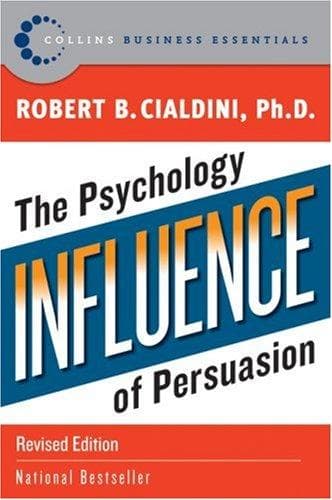
Influence
Robert B. Cialdini
“More behavioral-science persuasion than court intrigue; better for ethical influence.”
Buy on Amazon
Games People Play
Eric Berne
“If you want everyday social games without the ‘ruthless laws’ framing.”
Buy on AmazonRead Next
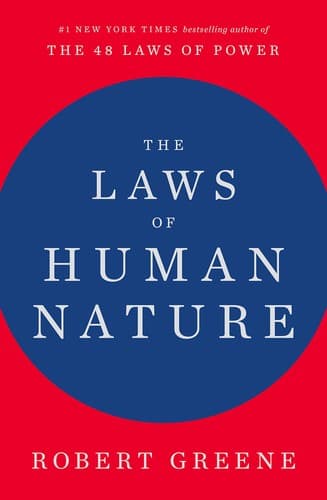
The Laws of Human Nature
Robert Greene
“Broader psychology and motive-reading; many readers see it as a more mature follow-up.”
Buy on Amazon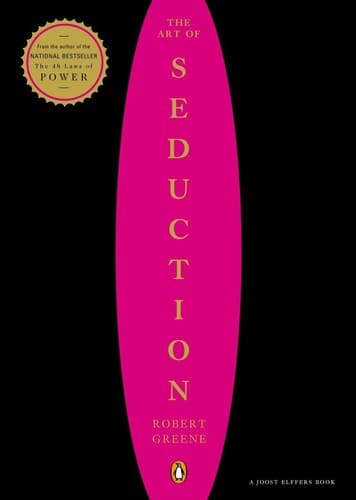
The Art of Seduction
Robert Greene
“Same Greene style applied to attraction/social influence (with similar ethical caveats).”
Buy on Amazon
The 33 Strategies of War
Robert Greene
“Strategic thinking and conflict framing, less ‘social’ and more competitive strategy.”
Buy on AmazonGo Deeper
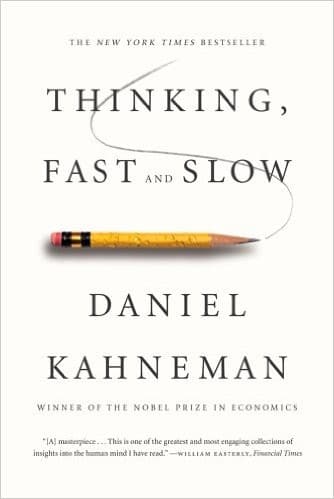
Thinking, Fast and Slow
Daniel Kahneman
“If you want the cognitive bias machinery behind influence and misreading people.”
Buy on Amazon
The Art of War
Sun Tzu
“Compact strategic principles; useful contrast to Greene’s long anecdotes.”
Buy on Amazon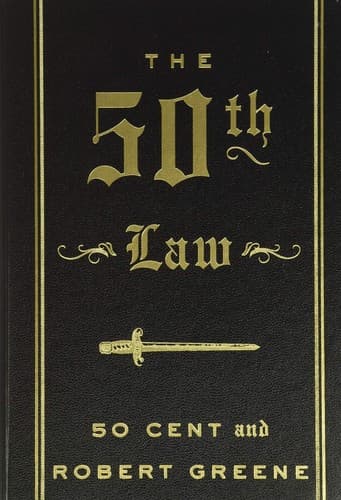
The 50th Law
50 Cent & Robert Greene
“Greene’s power lens mixed with fearlessness/resilience framing.”
Buy on AmazonWhat Readers Ask
It’s a catalog of 48 ‘laws’ drawn from historical power plays—how people gain, keep, and lose influence. Readers tend to treat it as a reality-check on politics rather than an instruction to be ruthless.
Most people suggest reading it once you have enough real-world context to separate observation from endorsement. If you’re younger, it can land as edgy; with experience, it reads more like a casebook.
The Culture
In the Wild
Critics & Podcasts
- Wikipedia — Baseline context: publication history and mainstream reception; useful for framing how the book became a long-lived bestseller.
- Goodreads — Quote/highlight ecosystem shows which lines people repeat and why the ‘laws’ format stays shareable.
- Medium (Design Leadership Notebook) — A critique arguing the ‘opposite of the 48 laws’ is what healthy leadership should aim for—useful for the backlash narrative.
What Kind of Book Is This?
Community Tags
Robert Greene
Author Credibility
American author known for books on strategy, power, and human behavior, including The 48 Laws of Power, The Art of Seduction, and Mastery.
Community Trust: Mixed. Readers generally respect Greene’s pattern-spotting and historical storytelling, but many distrust the framing because it can be read as endorsing manipulation. The crowd ‘trust’ is highest when the book is used as a diagnostic lens rather than a moral guide.
How to Read This
Best as: reference / dip-in
Most readers don’t read it straight; they skim laws, bookmark a few, and return when navigating a specific situation.
Shelf Life
Re-read when you change environments
It hits hardest when you enter a new job, industry, or social scene and need to decode incentives fast.
Homework Level
Light
No worksheets—your ‘homework’ is watching people and mapping situations to a law.
Best Life Stage
Early career → mid-career politics
Especially useful after your first few burns from office dynamics.
Aged well?
Despite being a late-90s book, people keep mapping it to modern workplaces and online influence. Criticism tends to be about tone/ethics more than relevance.
Actual genre
It reads less like classic ‘self-help’ and more like a historical casebook + strategy manual for influence and status.
Crowd consensus
Weaponization risk
Readers often warn that the ‘laws’ can become an excuse for cynicism. The healthier crowd take: learn the patterns to avoid being played, not to turn every interaction into a power game.
Reddit discussions
Reading identity
Recommending it often signals you’re into strategy, politics, and ‘real world’ social dynamics—and sometimes (fairly or not) that you’re comfortable with Machiavellian vibes.
Common misunderstandings
The biggest misread is treating the book as a moral ‘should’. Many discussions frame it as descriptive (how power has worked), and emphasize choosing when *not* to use tactics.
Reddit discussions