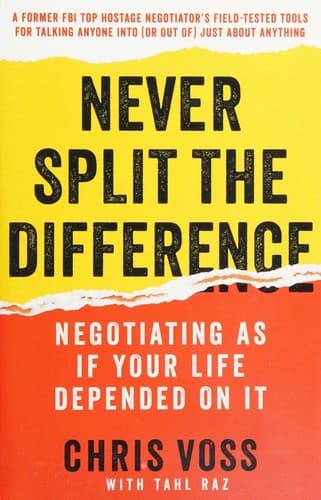
A field manual of negotiation scripts (mirroring, labeling, calibrated questions) that people swear they use weekly—though some readers worry the tactics can feel manipulative if you miss the empathy part.
Why It's Popular Right Now
It spread because it gives memorable, repeatable scripts—mirroring, labeling, and calibrated 'how/what' questions—that feel usable immediately in sales, salary talks, and everyday conflict.
Contents
Core Concepts
A negotiation toolkit built on tactical empathy: get the other side to feel understood, slow the conversation down, and use calibrated questions to make them solve the problem with you.
Mirroring
Repeat the last 1–3 key words (or the last phrase) to prompt elaboration without arguing.
Labeling
Name the emotion or dynamic ('It seems like…') to defuse tension and build rapport.
Accusation Audit
Preempt the negatives they’re thinking about you ('You probably think…') so they lose power.
Calibrated Questions
Use 'How' and 'What' questions to shift work to the other side ('How am I supposed to do that?').
No-Oriented Questions
Ask questions that let them say 'no' safely (it reduces defensiveness and creates control).
Get to “That’s right”
Aim for them to summarize your point and say “That’s right,” signaling real alignment.
The Reading Experience
Many readers recommend audio because tone/pacing matters for the scripts (calm voice, mirroring).
The Honest Take
Curated from 62.9K+ community discussions
Read If
- •You negotiate for a living (sales, procurement, recruiting, partnerships) and want phrases you can use tomorrow.
- •You freeze in conflict and want a calmer, step-by-step way to keep the other person talking.
- •You want to get better at boundaries and saying 'no' without escalating.
- •You like frameworks you can practice with friends or coworkers.
Skip If
- •You want win-win, relationship-first negotiation and dislike tactical language or 'psych tricks'.
- •You already read a lot of negotiation books and want brand-new theory, not a toolkit.
- •You hate anecdotal stories (FBI cases) and prefer purely academic research.
- •You’re looking for an ethics-heavy treatment rather than tactics.
What Works
Calibrated questions that force problem-solving
r/ChatGPTPromptGenius 941“First off, congrats on your negotiation. And for sharing the techniwue. But I have to say, hats off to that salesperson. Number one rule in sales isn’t to get what you want. But to make the other party think they got what THEY wanted. And they clearly did… You are doing cartwheels, because you avoided a 20% bump. The salesperson on the other hand is getting all buyers locked into 2 year extensions…”
Useful in real business negotiations (renewals, pricing, procurement)
r/sales 57“This was one of the best books I’ve read in a long time. Gap selling however has been trash. I’ll be posting my reasons for that soon.”
Sticky tactics (mirroring/labeling) you actually remember
r/IAmA 804“If I wanted to negotiate a deal to force Mexico to pay for a wall separating their country from our own, how should I approach the discussion?”
What Falls Flat
Can feel manipulative if you treat it like a bag of tricks
r/IfBooksCouldKill 15“I’m curious about this too. I remember listening to the audiobook about 10 years ago and loved it at the time. But I wonder if it’s flawed. I suspect it is.”
More scripts than theory
r/DarkPsychology101 176““A fundamental principle of human behavior is that once people make a choice or take a stand, they feel pressure to behave consistently with that commitment.” “The way to get someone to do what you want is not to argue with them, but to make it easy for them to persuade themselves.” “Persuasion is not about what you say; it’s about how the other person perceives what you say.” —Robert Cialdini....has several books on persuasion and influence “When dealing with people, remember you are not dealing with creatures of logic, but creatures of emotion.” —Dale Carnegie “If you would persuade, you must appeal to interest rather than intellect.” —Ben Franklin”
Real-Life Impact
“This was one of the best books I’ve read in a long time. Gap selling however has been trash. I’ll be posting my reasons for that soon.”
“First off, congrats on your negotiation. And for sharing the techniwue. But I have to say, hats off to that salesperson. Number one rule in sales isn’t to get what you want. But to make the other party think they got what THEY wanted. And they clearly did… You are doing cartwheels, because you avoided a 20% bump. The salesperson on the other hand is getting all buyers locked into 2 year extensions…”
“I think "What if they don't like me?" not in a inwardly focused manner, but in an overly concerned manner. Like I can't bear the thought of even slightly inconveniencing this person. I used to be so bad I would try to limit my breathing in public for fear that I may annoy passersby. I don't mind if people don't like me, I don't have a great personality, so it's pretty much a given that people won't. I really struggle with even seeing myself as equal to everyone else, like I'm some foreign bug that dares to walk among them.”
“I totally agree - it was when I started to understand that most people want to be heard and understood that it became easier for me to interact with others. During conversations I moved away from worrying about what I was going to ADD to the conversation, and instead focused on what a person is SAYING. I love your mention of "the mission of increasing net happiness on the planet," that's a great way to put it.”
“The most powerful word in negotiations is 'No.'”
— Chris Voss
The Quotes
From the Book
“The most powerful word in negotiations is 'No.'”
“When you hear 'That's right,' you know you've reached a breakthrough.”
“No deal is better than a bad deal.”
“Tactical empathy is understanding the feelings and mindset of another in the moment and also hearing what is behind those feelings.”
From the Crowd
“First off, congrats on your negotiation. And for sharing the techniwue. But I have to say, hats off to that salesperson. Number one rule in sales isn’t to get what you want. But to make the other party think they got what THEY wanted. And they clearly did… You are doing cartwheels, because you avoided a 20% bump. The salesperson on the other hand is getting all buyers loc...”
r/ChatGPTPromptGenius 941“If I wanted to negotiate a deal to force Mexico to pay for a wall separating their country from our own, how should I approach the discussion?”
r/IAmA 804“What's the best way to negotiate Salary for a new job? Answer this well and I'll buy your book right now.”
r/IAmA 652“How much does your voice, tone, and diction change when you are negotiating as opposed to just normally talking?”
r/IAmA 596“How important is Liam Neeson in reaching a satisfactory conclusion to an event?”
r/IAmA 592“I want a working helocopter with a trained pilot and a full tank... I have no leverage but am still making demands... Will you deiiver?”
r/IAmA 469The Crowd Splits: The Debate
While generally beloved, the community is divided on the book's depth and originality.
Is this ethical communication (tactical empathy), or manipulation with nicer words?
Is it a general-life book, or mostly a sales/corporate negotiation playbook?
The Bookshelf
Read Instead
Getting to Yes
Roger Fisher & William Ury
“More classic, win-win negotiation principles (BATNA, interests vs positions).”
Buy on Amazon
Influence
Robert B. Cialdini
“If you want persuasion psychology more than negotiation scripts.”
Buy on Amazon
Crucial Conversations
Kerry Patterson et al.
“Better for high-stakes relationship conversations and safety than bargaining.”
Buy on AmazonRead Next
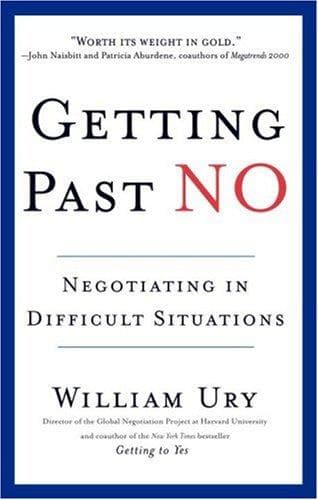
Getting Past No
William Ury
“A natural follow-on focused on handling resistance and hard counterparts.”
Buy on AmazonNever Split the Difference (MasterClass / talks)
Chris Voss
“If you want more examples and repetitions of the exact tools.”
Buy on Amazon
Difficult Conversations
Douglas Stone, Bruce Patton, Sheila Heen
“Pairs well when the goal is understanding, not a deal.”
Buy on Amazon

What Readers Ask
Crowd answer: readers say the book is best treated as a practice manual—pick 2–3 tools (mirroring, labeling, calibrated 'how/what' questions) and run them in low-stakes conversations before using them at work.
Crowd answer: readers say the book is best treated as a practice manual—pick 2–3 tools (mirroring, labeling, calibrated 'how/what' questions) and run them in low-stakes conversations before using them at work.
The Culture
In the Wild
Critics & Podcasts
- ValueSERP/YouTube results — The book is often summarized as a practical toolbox (mirroring/labeling/calibrated questions) rather than theory; most reviewers emphasize practicing the scripts.
- IAmA (Chris Voss) — Voss’s AMA threads reinforce the 'how/what' calibrated question approach and the focus on empathy as a negotiation lever.
- Sales community threads — Salespeople treat it as a playbook for renewals, pricing pushback, and procurement conversations—frequently recommending it as a top negotiation read.
What Kind of Book Is This?
Community Tags
Chris Voss
Author Credibility
Chris Voss is a former FBI hostage negotiator and the founder/CEO of The Black Swan Group, where he teaches negotiation and communication to businesses. He’s best known for translating hostage-negotiation techniques into everyday and professional conversations.
Community Trust: High. Readers tend to trust Voss because his advice comes from real high-stakes negotiation work (FBI cases) and the tactics are repeatedly reported as working in sales and workplace negotiations. Skeptics mainly worry about ethics—if used without genuine empathy, the tools can feel manipulative—but the credibility of his background is rarely disputed.
How to Read This
Best as: Audiobook
Many readers recommend audio because tone/pacing matters for the scripts (calm voice, mirroring).
Shelf Life
Re-read as needed
Works well as a reference—people come back to specific chapters before big conversations.
Homework Level
Yes — practice scripts
You get results when you role-play mirroring/labeling and test calibrated questions in low-stakes chats.
Best Life Stage
Negotiating often
Most useful when you’re doing sales, hiring, salary talks, or frequent conflict at work/home.
Has it aged well?
Most of the core tactics still feel modern because they’re human-psychology fundamentals, not platform-specific hacks. The FBI stories are dated but the scripts remain reusable.
Can this be weaponized?
Yes: the same mirroring/labeling techniques can be used to pressure or corner people. Readers argue ethics depends on intent and whether you’re also protecting the relationship.
What does reading this say about you?
You’re the kind of person who likes concrete scripts for tough conversations—and you probably work in (or admire) sales, dealmaking, or high-stakes communication.
Is there an upsell ecosystem?
Voss runs The Black Swan Group and training programs; some readers see the book as a gateway to paid negotiation coaching, while others treat it as a standalone toolkit.
Web + Reddit
What do people get wrong?
Many readers copy the phrases but skip the empathy: the book’s tools work best when you’re genuinely curious, not when you’re trying to 'win' with clever lines.