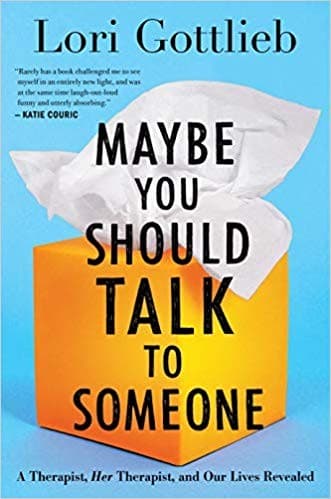
A warm, bingeable look at therapy that makes people feel seen — loved for its humanity and humor, criticized mainly if you expected a strict self-help playbook.
Why It's Popular Right Now
It broke out because it’s therapy content that doesn’t feel like therapy content — funny, human, and bingeable — while quietly giving readers a more realistic model of how people change.
Contents
Core Concepts
A narrative look at therapy from both sides of the couch: a therapist working with patients while also confronting her own life through therapy, showing how change actually happens — slowly, unevenly, and through honest self-confrontation.
Therapy as a relationship
Progress comes from the real, sometimes uncomfortable relationship between therapist and client, not from perfect advice.
Patterns over events
Sessions focus less on the single "problem" and more on the repeating patterns underneath it.
The therapist is human too
The book emphasizes that therapists have blind spots, emotions, and messy lives — and still can help.
Insight + action
Understanding yourself matters, but change shows up in what you do between sessions, not what you realize during them.
Change is non-linear
Breakthroughs are followed by backslides; the work is returning to the practice, not achieving a permanent fix.
The Reading Experience
Episodic chapters and story-driven pacing make it easy to binge; audiobook listeners often highlight the experience.
The Honest Take
Curated from 946+ community discussions
Read If
- •You want to understand what therapy is actually like (without jargon).
- •You like narrative nonfiction with real characters and emotional arcs.
- •You’re in a transition (breakup, burnout, identity shift) and want perspective, not hacks.
- •You prefer compassionate insight over “grindset” motivation.
Skip If
- •You want a tight, framework-heavy self-help manual with exercises.
- •You dislike memoir-style storytelling or long case narratives.
- •You’re looking for strictly clinical writing or evidence summaries.
- •You prefer short, punchy books over immersive narratives.
What Works
Human, funny, and unexpectedly moving
r/psychoanalysis 58“Really enjoyed it. I think she’s got a great style, more psychodynamic than analytical but still some good insights. Of course, it was written more for entertainment than for instructional purposes, but you can still get something out of it. You’ll get ignored or downvoted here because people in the sub can be a bit snooty and probably won’t touch your novel with a 10-foot-pole because it’s not a”
Makes therapy feel accessible (without sanitizing it)
r/books 42“I've read this one and really liked it! I highlighted these: - Don’t judge your feelings; notice them. Use them as your map. Don’t be afraid of the truth. - In idiot compassion, you avoid rocking the boat to spare people’s feelings, even though the boat needs rocking and your compassion ends up being more harmful than your honesty - responsibility for change lies squarely with the patient - Ha”
Audiobook-friendly storytelling
r/suggestmeabook 9“Highly recommend What my Bones Know by Stephanie Foo. Gottliebs book scratched the itch I had after reading Foo’s book, so perhaps the opposite can be true for you! I listened to the audiobook, which I’d also recommend, as she plays clips from some of her actual therapy sessions.”
What Falls Flat
Not a framework-heavy self-help book
r/books 1“Yes, I liked this book too, but then it got a bit boring in between and also too depressing. So i put it down for a couple years and then finished it recently. It was the audio version, and the narration was too good.”
Can feel long / meandering in parts
r/Book_Buddies 7“I stayed up until 1:15 in the morning this morning to finish this book. It was a book that I just enjoyed being inside of so much that it wasn't a race to the end for me, I really enjoyed going on the journey with each of the patients we got to know through the book. I know some people have griped that they didn't enjoy Lori's sessions and personal story as much, but I welcomed it and felt that it”
Real-Life Impact
“I stayed up until 1:15 in the morning this morning to finish this book. It was a book that I just enjoyed being inside of so much that it wasn't a race to the end for me, I really enjoyed going on the journey with each of the patients we got to know through the book. I know some people have griped that they didn't enjoy Lori's sessions and personal story as much, but I welcomed it and felt that it”
“I devoured this book and managed to complete it within a week. I read the book with a bias in mind that it would be something similar but not better than what I've read before by Josh Cohen i.e. How to Live, What to Do. In Search of Ourselves in Life and Literature. My partiality stemmed from my passion towards literature, or narratives that heavily reference works of literature, drawing the unive”
“I really loved this book! Made me 1) want to go to therapy or 2) become a therapist ..”
“Do you have advice on finding therapists that use a particular modality like CBT, Dialectical, or other approaches? It seems like a lot of legwork to find out. The PsychologyToday resource is better than nothing, but it isn't great. Asking for myself, and this is for my friends: How do you get someone into therapy when their attitude ks "therapy has never helped me, why waste my time?" Thanks”
“"The truth is, the hardest person to see is yourself."”
— Lori Gottlieb
The Quotes
From the Book
“"The truth is, the hardest person to see is yourself."”
“"Change is not a one-time event; it’s a process of returning—again and again—to what you know is true."”
“"We don’t get hurt because we’re broken. We get hurt because we’re human."”
From the Crowd
“Really enjoyed it. I think she’s got a great style, more psychodynamic than analytical but still some good insights. Of course, it was written more for entertainment than for instructional purposes, but you can still get something out of it. You’ll get ignored or downvoted here because people in the sub can be a bit snooty and probably won’t touch your novel with a 10-foot-pole because it’s not a”
r/psychoanalysis 58“I've read this one and really liked it! I highlighted these: - Don’t judge your feelings; notice them. Use them as your map. Don’t be afraid of the truth. - In idiot compassion, you avoid rocking the boat to spare people’s feelings, even though the boat needs rocking and your compassion ends up being more harmful than your honesty - responsibility for change lies squarely with the patient - Ha”
r/books 42“Just wanted to say thank you for posting score and genre of the daily books it is really helpful.”
r/audible 41“Lori, you recently wrote on Twitter that humans have an uncanny ability to choose a partner that has the characteristics of the parent that hurt them. What do you do when you can finally see that 26 years into a marriage with two kids? We are back in couples therapy again, and I've done a ton of individual work that has enabled me to see what I can see now. But I'm feeling trapped, as we just kee”
r/books 37“I haven't read it but i consider her the media therapist with the deepest and most transformative insights. I'm often appalled at the advice given on Reddit. The thought of so many people crowd sourcing advice on family, marriage and even work relationships makes me cringe.”
r/books 36“Hi, I've been told I should see a therapist for my anxiety, depression, what have you. One of my major 'issues' is that I don't trust anyone any more, or at least to the extent that they care about anything other than their own motivations. This extends to the idea of someone sitting across a table from me listening to my issues. In my head, they're not out to do what's best for me. They ar”
r/books 33The Crowd Splits: The Debate
While generally beloved, the community is divided on the book's depth and originality.
Is it self-help, or is it primarily narrative memoir?
Is the pacing worth the length?
The Bookshelf
Read Instead
Maybe You Should Talk to Someone
Lori Gottlieb
“Closer to home; if you want this exact vibe, this is it.”
Buy on AmazonThe Body Keeps the Score
Bessel van der Kolk
“More science/trauma-focused; heavier but more clinical.”
Buy on AmazonMan's Search for Meaning
Viktor E. Frankl
“Shorter and more philosophical; meaning-making under suffering.”
Buy on AmazonRead Next
Maybe You Should Talk to Someone (Workbook)
Lori Gottlieb
“If you want to translate themes into reflection.”
Buy on AmazonAttached
Amir Levine
“If relationships are your main lens, this adds a clear framework.”
Buy on AmazonDaring Greatly
Brené Brown
“For vulnerability/shame themes in a more self-help format.”
Buy on AmazonGo Deeper
On Becoming a Person
Carl Rogers
“Classic core text on humanistic therapy.”
Buy on AmazonThe Gift of Therapy
Irvin D. Yalom
“Therapy wisdom from a master clinician (more direct advice).”
Buy on AmazonMaybe You Should Talk to Someone: The Podcast
Lori Gottlieb
“If you want the voice and cases in audio form.”
Buy on AmazonWhat Readers Ask
It’s a therapy memoir told from both sides: Lori Gottlieb works with a handful of patients while she also becomes a patient after a personal crisis. The throughline is how change actually happens—through patterns, relationships, and uncomfortable honesty. In this book’s context, this shows up through the patient stories and the author’s own therapy arc. (Q1: What is the book "Maybe you should talk to someone?" about?…)
It’s best approached as a humane, story-driven window into therapy: not perfect, not clinical, but often deeply relatable. Your experience will depend on whether you come for stories or for tools. In this book’s context, this shows up through the patient stories and the author’s own therapy arc. (Q2: What illness does Lori Gottlieb have?…)
The Culture
In the Wild
Critics & Podcasts
- LoriGottlieb.com — Official podcast + essays extend the book’s themes into modern therapy conversations.
- Wikipedia — A quick factual snapshot of publication, reception, and author background.
- Goodreads — Reader reviews skew strongly positive, with frequent mentions of “funny + moving” and “made me want therapy.”
What Kind of Book Is This?
Community Tags

Lori Gottlieb
Author Credibility
Lori Gottlieb is an American psychotherapist and bestselling author. She writes and speaks about relationships, mental health, and the lived reality of change, blending clinical insight with accessible storytelling.
Community Trust: High. Readers tend to trust her because she is a practicing therapist and the book doesn’t read like a sales pitch. The tone is candid about limitations and messiness (including her own), which signals credibility rather than guru posturing.
How to Read This
Best as: Audiobook or paperback
Episodic chapters and story-driven pacing make it easy to binge; audiobook listeners often highlight the experience.
Shelf Life
Re-read when you hit a life transition
It lands hardest when you’re navigating heartbreak, career pivots, or identity questions.
Homework Level
Low — reflection heavy
More about seeing yourself clearly than doing worksheets; the “work” is noticing patterns.
Best Life Stage
When you’re stuck (or curious about therapy)
Ideal if you’re considering therapy or want to understand what it’s actually like.
Has it aged well?
Published in 2019, it still feels current because it’s about timeless themes (grief, identity, relationships) more than trends.
editorial
What genre is it really?
Therapy memoir / narrative nonfiction with self-help-adjacent insights, rather than a classic “framework” book.
editorial
Emotional weight
It can hit hard if you’re currently in therapy or in a raw season; many readers describe it as comforting but also tear-jerking.
crowd consensus
What does reading this say about me?
You’re curious about the inner mechanics of human change — and you prefer compassion and honesty over hustle culture. It signals “I’m willing to look at myself,” not “I want a productivity hack.”
editorial
Is there an upsell ecosystem?
Beyond the book, the author’s platform includes a podcast and public writing; readers sometimes notice the “brand” layer, but it’s not an aggressive funnel compared to many self-help titles.
editorial
What do people get wrong?
Many expect a therapist-authored book to be a step-by-step self-help system. It’s more like narrative nonfiction: the “lessons” arrive through patient stories and the therapist’s own arc.
crowd consensus