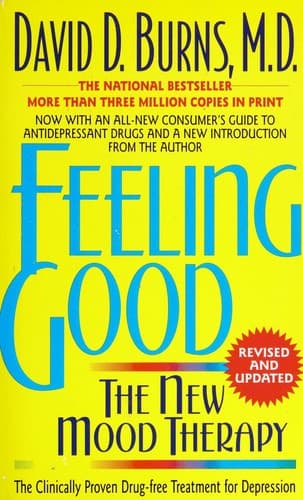
A CBT classic that many readers treat as a practical, do-it-yourself toolkit for mood—praised for concrete exercises, but criticized for length, repetition, and its 1980s tone.
Why It's Popular Right Now
It became a breakout classic by turning CBT into a DIY toolkit—direct, exercise-driven, and practical.
Contents
Core Concepts
A classic CBT guide: your mood is shaped by thoughts and interpretations. Learn to spot distorted thinking, challenge it, and use small behavior changes to shift how you feel. The book is meant to be practiced, not just read.
Cognitive distortions
Identify common thinking traps that amplify anxiety and depression.
Thought records
Write, examine, and reframe automatic thoughts to reduce emotional intensity.
Behavioral activation
Use small planned actions to break the “stuck” loop.
Test beliefs
Treat beliefs like hypotheses and run experiments.
The Reading Experience
Most value comes from doing the exercises on paper.
The Honest Take
Curated from 59.3K+ community discussions
Read If
- •You want a structured CBT toolkit you can actually practice
- •You’re stuck in rumination/anxiety loops and want concrete exercises
- •You prefer evidence-based methods over pure motivation
Skip If
- •You want a short modern read—this can feel long
- •You don’t want to do written exercises/homework
- •You’re in acute crisis and need professional support first
What Works
The worksheets actually change your thinking
r/CPTSDNextSteps 47“I read this book 20 years ago at uni and it changed my life. Ultimately I needed more than CBT, but it was huge to learn how much influence I could have over my days by doing these exercises. Every time you discover another strategy it gives you more hope 🤞🏻”
Concrete toolkit, not vibes
r/books 20“"Meditations" by Marcus Aurelius It's the quintessential handbook on how to be a man. Stoicism is basically old school CBT (Cognitive Behavioral Therapy). ”
Good as a reference manual
r/CBT 15“It was a mandatory read for me while I was in CBT treatment, I highly recommend it. ”
What Falls Flat
Too long / repetitive for some readers
r/books 52“I've stopped reading in my old age and it makes me sad. I play Stardew Valley instead. ”
Feels dated in tone/examples
r/books 49“I totally care. I have the same issue and you just inspired me to grab my Harry Potter books and give an old love another go. Happy reading. 📚”
Real-Life Impact
“"Feeling Good: The New Mood Therapy" by David Burns. The title makes it sound like a "pop" self-help book. It's not. It's actually the definitive text on how to learn and practice the techniques you'd learn in cognitive-behavioral therapy. (As it applies to depressive tendencies.) Well written. Gives straightforward exercises. You've just got to practice.”
“I've decided Jeff Bezos doesn't need another dime from me, ever. Mostly I reserve and check out books from the local library. If I decide I must own a copy for myself, I go to a local shop. Amazon shopping was a hard habit to break, but I feel better for having done so.”
“I try to use the local bookstore because they gave support to a nonprofit I work for. They also host a monthly book talk at the library and sell books for autographs. But sometimes for older or more obscure books you kinda have to go online.”
The Quotes
From the Crowd
“In my line of work I'm sometimes asked to give feedback to people whose artwork I find without merit. I use wording that steers clear of laying a judgement on it (bad/meandering/juvenile/confusing), and instead focus on two things: my own experience while reading it, and concrete things they can do to improve it. So, instead of, "The chronology is confused," you say, "I got a”
r/books 27.7K“There's a word for this, that should really be better known: velleity. "A desire to see something done, but not enough desire to make it happen." It's pretty much the default state of my life.”
r/books 8.5K“I'm going to go a different route I think. He is 84. As someone who has lossed all my grandfathers, I don't think you should tell him. I wouldn't put a rift in the relationship that you have with him for the few years he has left. Edit them, enjoy time with him. Don't discourage him from writing, it's amazing to me that at 84 he is writing a book, bad or not! You are very lucky”
r/books 3.3K“I just use my library, download kindle books for free, and hit up little book shops for one of a kind items”
r/books 2.2K“I care, dude! Same thing happened to me - I was always known as the guy with his head in a book but, apart from rare vacation reading, I didn’t read a book for about three years after smartphones took over. I kept getting hooked on stupid apps and free games. I finally got angry with myself, deleted the various apps and games from my phone, and show-horned reading back into ”
r/books 1.9KThe Crowd Splits: The Debate
While generally beloved, the community is divided on the book's depth and originality.
Is it too basic, or is the simplicity the point?
Is it too long, or is it a full CBT course in a book?
The Bookshelf
What Readers Ask
A DIY CBT classic: identify distorted thoughts, challenge them in writing, and use small behavior changes to shift mood. It’s built around exercises, not inspiration.
Best approach is tool-first: pick the exercise that matches your problem (rumination, self-criticism, worry), practice it repeatedly, and use the book as a reference when you get stuck.
The Culture
Critics & Podcasts
- Web — Referenced in reviews and recommendations for CBT-based self-help.
- Web — Referenced in reviews and recommendations for CBT-based self-help.
- Web — Referenced in reviews and recommendations for CBT-based self-help.
What Kind of Book Is This?
Community Tags
David D. Burns
Author Credibility
Psychiatrist and author best known for popularizing CBT self-help through Feeling Good. He has taught and written extensively on mood disorders and evidence-based cognitive therapy.
Community Trust: High. Readers tend to trust Burns because the book is aligned with mainstream CBT and feels like a practical toolkit rather than motivational fluff. Criticism is usually about tone/length, not credibility of the CBT approach.
How to Read This
Best as: Workbook
Most value comes from doing the exercises on paper.
Shelf Life
Keep it as a reference
Return to specific tools when you need them.
Homework Level
High
Works best if you practice the drills.
Best Life Stage
When you want a structured reset
Useful for rumination/anxiety loops.
Has it aged well?
The CBT core holds up; the tone/examples can feel dated. Many skim and focus on tools.
crowd consensus
What does reading this say about you?
You’re optimizing for practical mental tools over inspiration—more worksheet than “manifestation.”
editorial
What do people get wrong?
That you can read it once and be “fixed.” The payoff comes from practicing the exercises repeatedly.
crowd consensus