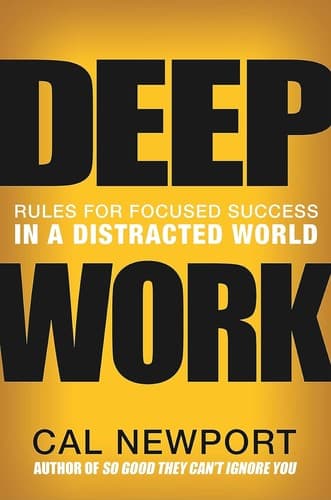
The internet’s most repeated argument for focus: deeply valuable for people who can control their schedule, but genuinely hard to apply inside meeting-heavy jobs.
Why It's Popular Right Now
It became the canonical ‘we’re all distracted’ book because it names a pain every knowledge worker feels—context switching—and gives a simple, defensible counter-move: schedule focus and treat attention as an asset.
Contents
Core Concepts
Deep Work argues that distraction-free concentration is a superpower: it helps you learn hard things faster, produce higher-quality output, and feel the satisfaction of real craft. The book’s pitch isn’t ‘be more productive’—it’s ‘design your days so deep work is possible, then train your attention like a muscle.’
Deep vs. shallow work
Treat focused, cognitively demanding work as a distinct category worth protecting—and treat shallow tasks as constrained overhead.
Time-blocking & planning your day
Decide in advance what each block of time is for, so “availability” doesn’t eat the whole day.
Embrace boredom
Stop reaching for stimulation the instant you feel friction; boredom tolerance becomes the foundation of focus.
Quit (or heavily constrain) social media
Use tools if they strongly support your goals; otherwise cut them to reclaim attention.
Drain the shallows
Cap email/meeting overhead with explicit limits so deep work has room to happen.
The Reading Experience
Readers treat it like a manual; highlighting the rules and re-reading sections helps implementation.
The Honest Take
Curated from 86.7K+ community discussions
Read If
- •You’re drowning in Slack/email and you can feel your ability to focus getting worse year over year.
- •You have at least some control over your calendar and can block uninterrupted time.
- •You’re learning hard things (coding, writing, research) and want a practice plan, not motivation.
- •You suspect your ‘busy’ days are mostly shallow work and you want a cleaner definition of high-value output.
Skip If
- •You work in a role where being ‘available’ is the job (support, ops, constant on-call) and you can’t negotiate boundaries.
- •You’re already doing consistent time-blocking and digital boundaries and want only cutting-edge novelty.
- •You hate books that repeat a simple idea across many examples.
- •You’re looking for a quick hack to fix ADHD symptoms (this helps environments; it’s not a medical solution).
What Works
Calendar boundaries beat motivation
r/productivity 30“At least for me, I'm not afraid to close my work email if I know I have a time-sensitive task. I'm routinely the guy who needs to have every email read and answered. The only time I ever have messages in my inbox is overnight. I'd distract myself through the middle of a task with a Teams message received or an email I opened and it would make my day go sideways quicker. Then trying to come back to the earlier task seemed a little more daunting. I block out times on my calendar specifically for this reason. On Fridays I schedule a "HARD STOP" after 2:30 PM because I've constantly received emails from people on a Friday trying to catchup from the week with an ASAP and exclamation mark. Sorry but the thing I emailed you about on Monday isn't an emergency for me at 3 PM on a Friday. Teams goes to DND from 2:30 until I leave. I needed to respect my time first before making everyone else respect it too.”
Environment design (make distraction harder than progress)
r/getdisciplined 1“The boredom torture thing is real and I think it works because it removes the option of "I'll do something easier first". There's nothing easier. You just sit there until working becomes the path of least resistance. What I've found helps a lot alongside this: blocking the apps that your brain reflexively opens. Not just turning off notifications — actually making them unreachable for a set window. The difference between "I shouldn't open Instagram" and "I physically can't open Instagram" is massive when your brain is in avoidance mode. The dopamine thing you described is exactly the mechanism. Once you've eliminated every easy escape, the hard thing starts to look appealing by comparison.”
Small “start” rituals that flip the brain into focus mode
r/getdisciplined 5“Very cool and interesting. Personally I have a soft version: a dedicated playlist for deep work. I noticed the same weird reflex you are describing: I switch to deep work mode when I start it. Caveat: don’t use it for anything else - and it’s a delicate balance between music you like and music you accept not to listen to at any other moment…”
What Falls Flat
Hard to apply in meeting-heavy cultures
r/nonfictionbookclub 10“I’m also convinced that deep work hold the key to a better quality working life and work product. However, I’m still trying to figure out how to practically apply it. Being absent for 3 hours every day is very difficult (working in a Big4).”
Not one-size-fits-all (life constraints, parenting, irregular hours)
r/nonfictionbookclub 6“My biggest issue with something like this is that nothing is one size fits all. I get the point here and I totally agree that deleting socials from your phone to avoid mindless scrolling (which I’m doing right now) and focusing your work without distractions when possible are good ideas that help increase productivity but I also raised my daughter while working (so I couldn’t just close the door) and work a non 9-5 job with regular nightly meetings so my day is more like 5 hours, big gap, 3 hours and even that’s not always consistent when having an on call job. So, yes, boundaries, yes, social media can drain both time and energy without being mindful of healthy parameters, and yes, plan and execute so as not to scatter, are great and useful ideas, but it’s the concepts that help and not one particular way of practicing them. Everybody’s life looks different and life is sometimes unpredictable.”
Real-Life Impact
“Hi Cal, I've read Deep Work and it has literally saved my PhD. Thanks! But I'm still struggling with unexpected changes to my schedule. I'm familiar with your methods around time blocking etc., my problem is more a problem of motivation. Often when a severe enough change of schedule is imposed on me, I start to think "why bother", and within a few minutes I've lost all ability to concentrate for the day. Is there any advice you could give me? Thanks again for your awesome work :-)”
“Yup - this is exactly how it started for me. The exact same video too! I've now been waking up at 4:30 daily for the past 3 years and it is, by far, the most productive addition to my life for the sole reason of 4 hours of undistracted time before work everyday. My benefits: (1) Read more (2) Hit the Gym and enjoy it (3) When random crap comes up I can approach it with a clear mind (4) I'm way more productive at work (get more done in less time)”
“It's unbelievable what a regular sleep rhythm can do to your life. I used to be a night owl, which caused me to wake up around 10-11 feeling tired and grumpy. Now I go to bed around 10-10:30 p.m. and wake up around 6 a.m., which has resulted in better energy levels throughout the day and improved my mental health. Remember to keep your rhythm during the weekends as well, at least in the beginning! Going to bed early is probably the easiest of habits to start, once you get started. Waking up is obviously the harder part of this, since snoozing is a habit to many. I used to snooze all the time until I started using an alarm app, which forces me to take a pre-defined picture with my phone. So now I have to get up from my bed to actually turn the alarm off. It's quite easy to go to the shower after that and start your day.”
“Wish someone had told me in my early 20s that scrolling isn't rest, just low-effort stimulation dressed up like a break. Your story perfectly explains how burnout isn't just about working too much but about never actually recharging. Love that you tracked your breaks like that, really smart. I did something similar a while back (less formal, just journaling post-break) and it opened my eyes to how even a 5-min walk or a bit of breathwork could reset my brain better than an hour of YouTube ever could!”
“The wall staring thing sounds insane but I actually tried something similar a few months ago and it kinda works. I used to go straight from watching youtube to trying to study and my brain just refused. Like it felt physically painful to read a textbook after 20 minutes of shorts. What worked for me was just sitting with my phone in another room for like 5 minutes before starting. Not even staring at a wall, just sitting there doing nothing. You'd be surprised how quickly your brain gets desperate for something to do. Then cracking open a book actually feels like relief instead of punishment.”
“Develop the habit of letting small bad things happen. If you don't, you'll never find time for the life-changing big things.”
— Cal Newport
The Quotes
From the Book
“Develop the habit of letting small bad things happen. If you don't, you'll never find time for the life-changing big things.”
“To produce at your peak level you need to work for extended periods with full concentration on a single task free from distraction.”
“When you work, work hard. When you're done, be done.”
“Decide in advance what you're going to do with every minute of your workday.”
From the Crowd
“Hi Cal, I've read Deep Work and it has literally saved my PhD. Thanks! But I'm still struggling with unexpected changes to my schedule. I'm familiar with your methods around time blocking etc., my problem is more a problem of motivation. Often when a severe enough change of schedule is imposed on me, I start to think "why bother", and within a few minutes I've lost all ability to concentrate for the day. Is there any advice you could give me? Thanks again for your awesome work :-)”
r/IAmA 19“The wall staring thing sounds insane but I actually tried something similar a few months ago and it kinda works. I used to go straight from watching youtube to trying to study and my brain just refused. Like it felt physically painful to read a textbook after 20 minutes of shorts. What worked for me was just sitting with my phone in another room for like 5 minutes before starting. Not even staring at a wall, just sitting there doing nothing. You'd be surprised how quickly your brain gets desperate for something to do. Then cracking open a book actually feels like relief instead of punishment.”
r/getdisciplined 15“Yup - this is exactly how it started for me. The exact same video too! I've now been waking up at 4:30 daily for the past 3 years and it is, by far, the most productive addition to my life for the sole reason of 4 hours of undistracted time before work everyday. My benefits: (1) Read more (2) Hit the Gym and enjoy it (3) When random crap comes up I can approach it with a clear mind (4) I'm way more productive at work (get more done in less time)”
r/productivity 58“thanks! now it’s time to take a screenshot and never look at it again”
r/ADHD 1.1KThe Crowd Splits: The Debate
While generally beloved, the community is divided on the book's depth and originality.
Is "deep work" mostly about removing distractions, or about redesigning your job and commitments?
Does strict scheduling / time-blocking create freedom, or does it become obsessive micromanagement?
The Bookshelf
Read Instead
Getting Things Done
David Allen
“If your pain is overwhelm, GTD is a better capture/next-actions system than a focus manifesto.”
Buy on AmazonAtomic Habits
James Clear
“More behavior-design and consistency; complements Deep Work if you struggle to build routines.”
Buy on AmazonIndistractable
Nir Eyal
“More tactical on distraction triggers and commitments; less philosophical than Newport.”
Buy on AmazonRead Next
Digital Minimalism
Cal Newport
“If Deep Work landed, this is the next step: rebuild your relationship with tech.”
Buy on AmazonThe Effective Executive
Peter F. Drucker
“Classic on doing the right work (not just more work).”
Buy on AmazonSo Good They Can't Ignore You
Cal Newport
“Same “craftsmanship” worldview applied to careers and skill building.”
Buy on AmazonGo Deeper
Flow
Mihaly Csikszentmihalyi
“The psychology behind optimal focus and engagement.”
Buy on AmazonThe Shallows
Nicholas Carr
“Stronger cultural/brain argument about what the internet does to attention.”
Buy on AmazonEssentialism
Greg McKeown
“Focus before focus: reduce commitments so deep work can exist.”
Buy on AmazonWhat Readers Ask
It’s a case for distraction-free concentration as a career advantage, plus four rules (work deeply, embrace boredom, quit social media, drain the shallows) to make it possible in real life.
Most readers find it straightforward but not “breezy”—it repeats the idea with many examples. Treat it as a manual: skim stories, underline the rules, then implement.
The Culture
In the Wild
Critics & Podcasts
- Ali Abdaal — A creator-oriented framing: treat deep work as the engine behind shipping meaningful output, not a purity ritual.
- Learning Leader Show — Positions deep work as a leadership advantage: fewer priorities, higher quality decisions, and protecting thinking time.
- College Info Geek — Breaks down the book into tactics for students/knowledge workers (focus blocks, batching, constraints).
What Kind of Book Is This?
Community Tags
Cal Newport
Author Credibility
Computer science professor and writer focused on productivity and meaningful work. Known for arguing that skills, focus, and deliberate practice beat “passion-first” career advice.
Community Trust: High. Across discussions, Newport is generally treated as a credible, practical voice on work and productivity. Readers cite his ideas as a useful counter to vague “follow your passion” advice, and he’s often referenced alongside his other work (e.g., Deep Work). The main skepticism is usually about whether the thesis applies universally, not about his integrity.
How to Read This
Best as: Paperback/Kindle (for marking rules + checklists)
Readers treat it like a manual; highlighting the rules and re-reading sections helps implementation.
Shelf Life
Re-read yearly (or before big projects)
Most value comes when you’re about to start a demanding project and can reset boundaries.
Homework Level
Yes — you’ll need calendar blocks + tool restrictions
To get results you must schedule deep work and constrain shallow channels (email/Slack/social).
Best Life Stage
Career builders / students / creators
Especially useful when learning hard things or shipping output matters more than constant responsiveness.
Aged well (maybe more relevant now).
The “Slack/meetings/notifications” complaints have only intensified since 2016; readers still describe the same core problem: context switching and dopamine loops.
Based on discussions across r/nonfictionbookclub
Reading this signals you care about craft (and you’re tired of shallow hustle).
In productivity communities, Deep Work functions as a shibboleth: you’re not optimizing to look busy; you’re trying to protect real thinking time.
Based on discussions across r/productivity
People think deep work = willpower. It’s mostly systems.
The strongest Reddit signal is that distraction is a “setup problem.” People get results when they change the environment (blocks, DND, timers), not when they merely try harder.
Based on discussions across r/getdisciplined