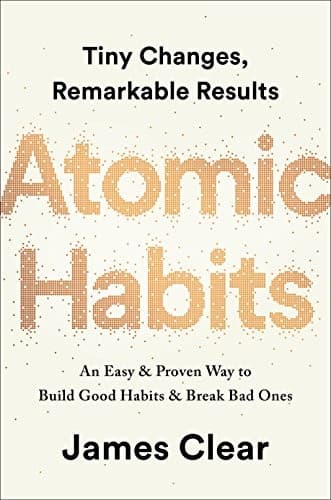
Reddit’s default starter manual for habit change: genuinely actionable (systems, environment, 2-minute starts), but criticized for being padded, repetitive, and a bit ‘blog-post stretched to book length.’
Why It's Popular Right Now
Atomic Habits became the default habit book because it turns ‘discipline’ into levers you can actually pull: environment design, tiny starts, and a repeatable checklist (the 4 laws). It’s simple enough for beginners to execute — and memorable enough to become quote cards and infographics.
Contents
Core Concepts
The book argues that lasting change comes from building better systems — small behaviors, repeated consistently, shaped by your environment — rather than relying on motivation or big goals. Focus on identity (‘who I’m becoming’) and design the cues, friction, and rewards so the right actions become automatic.
Identity-based habits
Focus on becoming the kind of person who does the habit, not just hitting a target once.
Habit loop
Cue → craving → response → reward: change the loop, change the behavior.
Four Laws of Behavior Change
Make it Obvious, Attractive, Easy, Satisfying (and invert them to break bad habits).
Two-Minute Rule
Scale the habit down to a 2-minute ‘starter version’ to beat the friction of starting.
Environment design
Change what’s around you so the right choice becomes the easy choice.
Compounding
Small improvements add up; consistency beats intensity.
The Reading Experience
Many readers treat it as a ‘relisten’ reference; frameworks are easy to replay and reapply.
The Honest Take
Curated from 58.6K+ community discussions
Read If
- •You’re stuck in ‘I know what to do’ and need a simple system to actually do it.
- •You want habit-building that’s more about designing your environment than grinding willpower.
- •You’re rebuilding your routines (new job, new city, post-burnout) and need a clean baseline.
- •You like checklists, rules-of-thumb, and small daily actions more than motivational hype.
Skip If
- •You’ve read 5+ habit books and you’re hunting for novel, research-heavy insights.
- •You hate repetition and chapter recaps — you’ll feel like it could’ve been a long article.
- •You’re looking for therapy-level personalization (ADHD, trauma, depression) more than general frameworks.
- •You want an ideology or philosophy book — this is a tactics-and-systems manual.
What Works
Systems & environment (less willpower)
r/r/getdisciplined 17“He does mention this in the book. Make it easy and automatic based on the environment instead of relying on willpower.”
Memorable, repeatable quote-level rules
r/r/ADHD 5“Reading it now. "You do not rise to the level of your goals, you fall to the level of your systems" knocked me out.”
Identity shift reduces shame and increases consistency
r/r/productivity 46“I've read this book probably ten times now... the biggest point left out is the difference between identity, goal and behavior based changes.”
Habit stacking as a practical trigger
r/r/productivity 88“Do you recommend we read the book? Or is habit stacking the gist?”
What Falls Flat
Feels padded / could be shorter
r/r/getdisciplined 17“That being said I thought there was a lot of fluff and you could get the book's message across in 5 pages rather than a couple hundred.”
Repetition / overexposure
r/r/productivity 318“I think the overall message was good but I found the book a bit repetitive.”
Not personalized enough for neurodivergent brains
r/r/ADHD 492“Read it, used it. It took me two weeks to go from newly learnt Atomic Habits to old me habits.”
Real-Life Impact
“66 days clean of Nicotine! No cravings or desires to go back. I used strategies from James Clear...”
“I used Atomic Habits for studying and it actually worked.”
“After reading the book "Atomic Habits", I developed the habit of going to bed early...”
“Atomic Habits helped me stop procrastinating and actually get my life together.”
“You do not rise to the level of your goals. You fall to the level of your systems.”
— James Clear
The Quotes
From the Book
“You do not rise to the level of your goals. You fall to the level of your systems.”
“Every action you take is a vote for the type of person you wish to become.”
“Your outcomes are a lagging measure of your habits.”
“If you can get 1 percent better each day for one year, you'll end up thirty-seven times better by the time you're done.”
From the Crowd
“Read it, used it. It took me two weeks to go from newly learnt Atomic Habits to old me habits. The book is great and it teaches you things, but as with all things in life, consistency is key...”
r/r/ADHD 492“I think Atomic Habits is good for developing discipline... Then, after burning yourself out, read 4000 Weeks Later by Oliver Burkeman.”
r/r/getdisciplined 507“Have to literally lol everytime I read about atomic habits here! Not because of the book, but because of the fact that said book has been laying on my nightstand for ~4 years...”
r/r/getdisciplined 82“I must be the only person here who thinks Atomic Habits is overrated. The price of the app is also rubbish.”
r/r/productivity 7“I read Atomic Habits and thought it was fine. But I push back on the framing of fantasy or romance or fiction as not “productive.””
r/r/fantasyromance 641The Crowd Splits: The Debate
While generally beloved, the community is divided on the book's depth and originality.
Is Atomic Habits ‘life-changing’ or just a blog post stretched into a book?
Is the official Atomic Habits app (Atoms) a helpful companion or a $16/mo cash grab?
Does the ‘1% better every day’ idea inspire consistency or create unrealistic expectations?
The Bookshelf
Read Instead

The Power of Habit
Charles Duhigg
“More narrative + ‘habit loop’ explanation; less tactical checklists.”
Buy on Amazon
Tiny Habits
BJ Fogg
“If you want an even more ‘micro-habit’ and behavior-design lens.”
Buy on Amazon
Getting Things Done
David Allen
“If your problem is overwhelm and task capture/processing, not habits.”
Buy on AmazonRead Next

Deep Work
Cal Newport
“Once your basic habits are stable, go after focus and distraction.”
Buy on Amazon
Essentialism
Greg McKeown
“Pairs well with Atomic Habits by cutting commitments so habits can stick.”
Buy on Amazon
Drive
Daniel H. Pink
“For motivation/psychology once you’ve got the mechanics of habits.”
Buy on AmazonGo Deeper

Four Thousand Weeks
Oliver Burkeman
“A philosophical counterbalance if habit optimization starts to feel obsessive.”
Buy on Amazon
Mindset
Carol S. Dweck
“Goes deeper on identity and learning orientation — the ‘why’ behind persistence.”
Buy on Amazon
The Compound Effect
Darren Hardy
“If you want the ‘small actions compound’ idea in a more motivational/business tone.”
Buy on AmazonWhat Readers Ask
For most readers, yes — especially if you want a step-by-step system (not motivation) to build consistency. The main knock is that the ideas can feel repetitive if you’ve already consumed a lot of habit content, but many people still find the structure useful enough to apply.
It’s a practical playbook for changing behavior through tiny, repeatable actions that compound over time. The core message is: build systems (environment + process) instead of obsessing over goals.
The Culture
In the Wild
Critics & Podcasts
- If Books Could Kill (podcast) — Often cited when people want a skeptical ‘this is productivity culture’ critique — useful counterweight if the book makes you feel like every hobby must be optimized.
- JamesClear.com — Atomic Habits page — Official framing of the thesis + the famous compounding graphic that drove a lot of the book’s meme spread.
- Wikipedia — Neutral reference for publication details and broad positioning as a systems-based habit book.
What Kind of Book Is This?
Community Tags

James Clear
Author Credibility
James Clear is a writer and speaker focused on habits, decision-making, and continuous improvement. He writes the popular 3-2-1 newsletter and is best known for Atomic Habits, a #1 New York Times bestseller that popularized a systems-first approach to behavior change.
Community Trust: Mixed. On Reddit, Clear is generally seen as a credible, practical synthesizer rather than a groundbreaking scientist. Readers trust him because the framework is simple, usable, and feels aligned with behavioral science, but a recurring minority push back that the book is padded, repeats itself, and occasionally overclaims with slogans (like the 1% line) or science-lite anecdotes. Net: high usefulness, moderate skepticism about originality/depth.
How to Read This
Best as: Audiobook or Paperback
Many readers treat it as a ‘relisten’ reference; frameworks are easy to replay and reapply.
Shelf Life
Re-read when habits slip
Fans often use it as a reset — not for new info, but to get back to basics.
Homework Level
Yes — light worksheets help
Works best when you actually do environment tweaks + track tiny starts for 2–4 weeks.
Best Life Stage
When you’re rebuilding consistency
Great for fresh starts (new job, post-burnout, moving, quitting a vice) where you need a stable routine again.
Has it aged well?
Despite being a 2018 book, it remains the default recommendation for ‘how do I build habits?’ because the core ideas are evergreen: environment design, consistency, and identity-based change. The main aging critique is not ‘outdated’ but ‘overexposed’ — many readers feel they’ve already absorbed it via social posts and summaries.
Based on community discussions
What does reading Atomic Habits say about you?
You’re signaling ‘I want execution, not inspiration.’ It’s the book people mention when they’re rebuilding basics — new routines, new discipline, a practical reset. In some circles it also signals ‘mainstream productivity,’ which is why some readers push back against treating fiction/romance as ‘unproductive.’
Based on community discussions
Is there an upsell ecosystem?
Yes — discussions frequently reference paid products around the brand (especially the official app). A notable Reddit mini-drama is the sticker shock at ~$16/month for the Atoms app, with many commenters calling it a cash grab and recommending cheaper alternatives.
Based on community discussions
What do people get wrong?
Two common misunderstandings show up repeatedly: (1) taking ‘1% better every day’ literally (and then rejecting it as impossible), and (2) expecting motivation to magically appear instead of changing the environment and making the start frictionless. Threads often circle back to ‘make it easier’ and ‘design cues.’
Based on community discussions